The 1973 model year was the last for the original 911 generation. The S retained the long hood and slender bumpers, with a 2.4-litre flat-six at the back.
The S combined mechanical fuel injection with a five-speed gearbox and a front spoiler shaped by lessons from the racetrack. With peak power of 190 PS at 6,500 rpm, the engine rewards using the gears.
The 2.4 S, by the numbers: Porsche’s period specification.
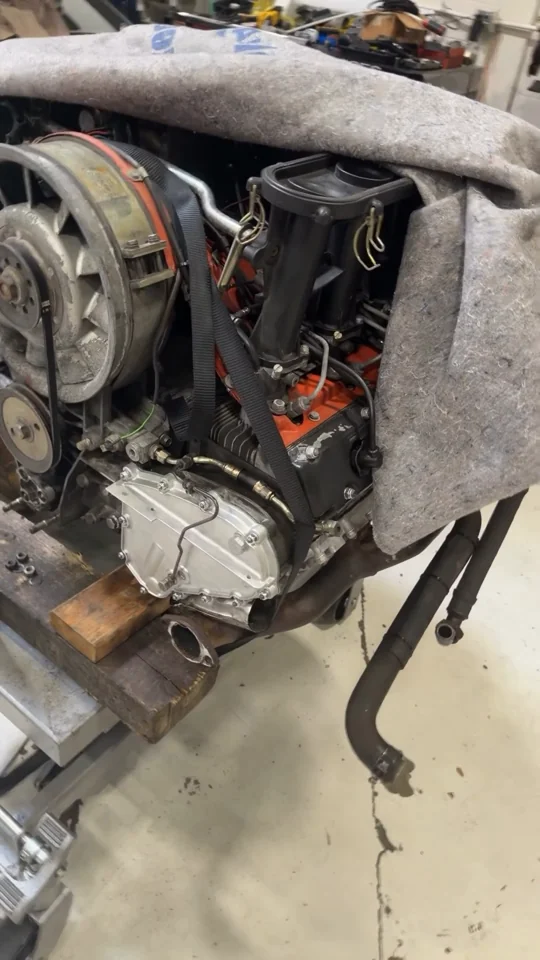
Three cylinders sit on each side of the crankshaft, facing those on the opposite side. This horizontally opposed arrangement gives the flat-six its name and keeps the engine’s mass low. Mounted behind the rear axle, it puts weight over the driven wheels and gives the 911 its distinctive balance.
02 / AIR-COOLED
Cooling you can hear.
A fan sends air over the finned cylinders and cylinder heads, carrying heat away without a conventional water-cooling circuit. Engine oil plays an important role in managing heat, too. The fan, valves and exhaust all contribute to the early 911’s unmistakably mechanical soundtrack.
03 / FORM WITH A PURPOSE
The sporting details.
The 2.4 S’s front spoiler grew out of Porsche’s aerodynamic work and helped directional stability at speed. The five-spoke Fuchs wheel design has its own S heritage: forged alloy Fuchs wheels first appeared on the 1967 model-year 911 S. Slender bumpers and the long hood complete the early silhouette.
Follow the original 911’s development from F. A. Porsche’s first proposals to the longer wheelbase and the 2.4-litre S, with period road tests and owners’ perspectives.
Ask an early 911 enthusiast about mechanical fuel injection and the conversation soon turns to feel: the eager response to a small movement of the pedal, the intake sound, the pleasure of letting an S engine climb through its rev range.
Camshafts, airflow, ignition and exhaust work with the injection system to shape the way an S engine delivers its power.
mfiMECHANICAL FUEL INJECTION
A fuel map you could hold in your hand.
The space cam: precision shaped in metal.
01 / HOW IT THINKS
Before the electronic brain.
The Bosch pump meters fuel mechanically. A contoured, three-dimensional “space cam” helps translate engine speed and accelerator position into the required delivery. Its shape serves as a physical fuel map. Separate mechanisms compensate for warm-up and atmospheric pressure.
02 / HOW IT BREATHES
Six throttles, working together.
Each cylinder has its own throttle butterfly. Linkages coordinate those throttles with the injection pump, so airflow and fuel delivery rise together as the pedal moves. Synchronizing them gives each cylinder the airflow it needs for smooth, even running.
03 / THE CRAFT OF TUNING
Make everything agree.
Porsche’s factory approach was “Check, Measure, Adjust”: establish the engine and ignition fundamentals, check injection timing and linkage, synchronize the throttles, then measure the mixture. Each adjustment depends on getting the preceding checks right.
Further reading: the engineering and the enthusiasm